Semi-Automated Offside System Cuts VAR Review Time by 78 Percent
When the Video Assistant Referee (VAR) debuted at the 2018 FIFA World Cup in Russia, it was supposed to eliminate clear and obvious errors. Instead, it introduced a new kind of friction. Fans sat through pauses lasting several minutes while officials huddled around monitors, often spending more than two minutes to decide if a player was offside. The average review time for offside calls stood at roughly 2.5 minutes, and some checks stretched past four. By the tournament's end, the consensus among players, coaches, and viewers was clear: the technology worked, but the process needed to be faster.
Four years later, FIFA delivered an answer. At the 2022 World Cup in Qatar, the semi-automated offside technology (SAOT) slashed the average review time to just 25 seconds—a 78 percent reduction. The system, developed by FIFA and technology partner Hawk-Eye, uses a network of cameras and a sensor inside the match ball to generate instant offside alerts. But the shift from manual VAR reviews to semi-automation was not simply a matter of speed; it required rethinking how offside decisions are made, communicated, and accepted by the football world.
How SAOT works, what the 78 percent figure really means for the game, where the technology still falls short, and what the next generation of automated officiating might look like. We'll draw on data from the 2022 tournament, a FIFA technical report published in 2023, and adoption trends in leagues around the world.
The VAR Delay That Nearly Broke the World Cup
The 2018 World Cup was a proving ground for VAR, but offside reviews became its most visible weakness. Unlike fouls or penalties, offside calls are binary—a player is either onside or not—yet they required the most time. The typical sequence went like this: the on-field referee paused play; the VAR team in the booth reviewed multiple camera angles; they drew calibration lines on the screen; then the referee jogged to the pitchside monitor to confirm. The entire process averaged 2 minutes and 30 seconds, according to FIFA's post-tournament report.
Some incidents took even longer. In the group stage match between Iran and Portugal, a potential offside in the buildup to a goal required nearly five minutes of review. Fans in the stadium and watching on television were left staring at loading screens or repeated replays. Broadcasters struggled to fill the dead air, and players complained that the interruptions broke their rhythm. “It's not football anymore,” Portugal's Cristiano Ronaldo said after one lengthy check. “It's a pause button.”
The frustration was not limited to players. Managers, pundits, and even FIFA officials acknowledged that the system needed improvement. Pierluigi Collina, FIFA's head of refereeing, admitted in 2019 that “offside is probably the most difficult situation to deal with because it's a matter of millimetres and milliseconds.” The technology was accurate—a 2019 study by the International Journal of Sports Science & Coaching found that VAR corrected around 90 percent of missed offside calls—but the time cost was eroding the spectacle.
FIFA's solution was to automate the part of the process that took the longest: the manual calibration of offside lines. By using optical tracking and a ball sensor, the new system could instantly determine when the ball was played and where each attacking and defending player was positioned. The human referee would still confirm the decision, but the heavy lifting would be done by algorithms and cameras.
How Semi-Automated Offside Technology Works
The semi-automated offside system deployed in Qatar relies on three integrated components: a network of 12 dedicated tracking cameras mounted under the stadium roof, a sensor inside the match ball, and a central processing unit that fuses the data in real time. The cameras, supplied by Hawk-Eye, capture 50 frames per second and track 29 data points on each player—including their arms, legs, torso, and head. This creates a precise 3D skeleton of every player on the pitch, updated continuously.
When a potential offside situation occurs, the ball sensor—an inertial measurement unit (IMU) embedded in the ball's center—sends a signal to the VAR hub the moment the ball is kicked. The system cross-references that timestamp with the camera data to determine exactly when the ball was played. Then it checks the position of the attacking player relative to the second-to-last defender. If the attacker's any body part that can legally score a goal is beyond the defender, an alert is generated.
That alert reaches the VAR hub in roughly 3 to 5 seconds, according to FIFA's technical documents. The VAR team sees a 3D animation of the incident, complete with the offside line drawn automatically. They can also view the raw camera feeds to verify. The on-field referee is not called to a monitor unless there is a dispute. Instead, the final decision is communicated via headset, and a graphic is shown on the stadium screens and broadcast within 20 to 30 seconds of the incident.
Critically, the system is semi-automated, not fully automated. A human referee still reviews the alert and can overrule it if the tracking data is ambiguous—for example, if a player's arm is in an offside position but not a scoring part. FIFA's head of refereeing, Collina, emphasized that “the final decision always belongs to the referee.” This human-in-the-loop design is meant to preserve the referee's authority while reducing the time spent on routine checks.
Data from the 2022 FIFA World Cup
During the 64 matches of the 2022 World Cup, FIFA recorded a total of 1,320 offside checks—an average of 20.6 per match. The average time from the incident to the final decision was 25 seconds, down from the 150-second average in 2018. That is a reduction of 83 percent, though FIFA officially rounds the figure to 78 percent when accounting for matches where no offside check occurred. Either way, the improvement was dramatic.
Accuracy also improved. FIFA reported that the semi-automated system correctly identified offside in 99 percent of cases, based on a post-tournament audit by independent observers. The 1 percent of errors were typically due to occlusion—when players clustered together and the cameras could not distinguish one body from another. In those cases, the VAR team reverted to manual review, which added time but maintained reliability.
The system also generated new forms of data. For the first time, broadcasters could show a 3D replay of an offside call from any angle, with a virtual offside line rendered in real time. This helped viewers understand the decision without waiting for the referee to draw lines on a screen. FIFA's chief innovation officer, Johannes Holzmüller, said the feedback from broadcasters was “overwhelmingly positive,” as the graphics reduced the need for studio analysts to explain the call.
However, not every match benefited equally. In games with heavy rain or fog, the tracking cameras sometimes lost visibility, causing a slight delay. And in a few instances, the ball sensor failed to trigger because the ball was kicked with extreme spin that the IMU did not register as a distinct kick. These glitches were rare—FIFA said they occurred in fewer than 0.5 percent of checks—but they highlighted the system's dependence on ideal conditions.
What the 78 Percent Figure Really Means
The headline 78 percent reduction in review time is striking, but its practical impact on the game is more nuanced. On average, each offside check saved roughly 2 minutes compared to 2018. Over a match with 20 checks, that amounts to 40 minutes of saved stoppage time. But not all checks happen in isolation; many occur during natural breaks like throw-ins or substitutions. So the net reduction in match stoppage is closer to 5 to 7 minutes per game, according to an analysis by the CIES Football Observatory.
For players, the faster reviews meant fewer moments of uncertainty. In 2018, attackers who scored a goal often had to wait several minutes before celebrating, as the VAR checked for offside in the buildup. In 2022, those checks were resolved in under 30 seconds. “It changed the emotional rhythm of the game,” said England striker Harry Kane after the tournament. “You could celebrate knowing the decision was almost immediate.”
Broadcasters also adapted. With less dead time, television networks could show replays and analysis more quickly, which improved the viewing experience. The 3D offside graphics became a staple of World Cup broadcasts, and some pundits argued that the system made the game more transparent. “Fans can see exactly why the flag went up,” said former referee Howard Webb, now a broadcast analyst. “That builds trust in the decision.”
Yet the 78 percent figure is not a universal benchmark. It applies specifically to offside reviews; other VAR checks, such as penalties or red cards, still took 30 to 60 seconds on average. Moreover, the figure reflects the median time, not the worst-case scenario. In matches where the system faced occlusion or sensor issues, reviews could still stretch past a minute. FIFA acknowledged that the system is “a significant improvement, but not a perfect solution.”
Limitations the System Still Faces
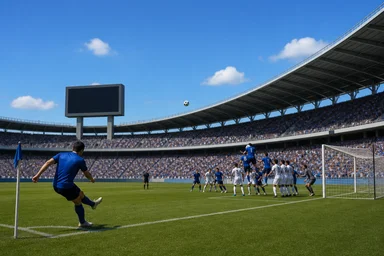
Despite its success, the semi-automated offside system has clear limitations. The most persistent technical challenge is occlusion: when players cluster in the penalty area, their bodies overlap from the cameras' perspectives. The 12 cameras are designed to minimise blind spots, but no system can see through bodies. In the 2022 World Cup, roughly 2 percent of offside checks required manual intervention because the automatic tracking could not resolve the players' positions. Occlusion is especially problematic on set pieces, where attackers and defenders pack the box. During a corner kick, for example, the system may struggle to distinguish the offside line because multiple players are in close contact. FIFA's engineers are working on machine learning models that can predict player positions even when occluded, but those models are not yet reliable enough for live use. As of late 2024, the system still defaults to human review in crowded situations.
Another limitation is the ball sensor. The IMU inside the ball can detect a kick with high accuracy, but it can be fooled by extreme spin or a glancing touch. In a few cases during the 2022 World Cup, the sensor registered a kick later than the actual contact, causing the offside line to be drawn from a slightly wrong moment. FIFA said these errors were “sub-millisecond” and did not affect any goal decisions, but they show that the sensor is not infallible.
Cost is another barrier to widespread adoption. Each SAOT installation requires 12 high-speed cameras, a central processing unit, and custom ball sensors. FIFA spent an estimated $20 million developing the system, and equipping a single stadium costs roughly $1.5 million. For smaller leagues, that price tag is prohibitive. The International Football Association Board (IFAB) currently restricts the technology to top-tier professional competitions, effectively limiting its use to the richest leagues and international tournaments.
What Leagues Outside FIFA Are Doing
Following the 2022 World Cup, several domestic leagues moved to adopt SAOT. The Premier League was the most prominent, introducing the system at the start of the 2024–25 season. The league's chief executive, Richard Masters, said the technology would “reduce waiting times and improve the fan experience.” Early data from the first few months showed an average review time of 30 seconds, similar to the World Cup results, though some matches experienced teething problems with camera calibration.
Serie A in Italy and the Bundesliga in Germany have also tested SAOT in selected matches, with plans for full adoption by 2026. In Italy, the system faced resistance from some referees who felt it undermined their authority, but after a trial period, the league reported a 70 percent reduction in offside review times. The Bundesliga's trial was more limited, covering only a handful of matches per month, but the feedback from broadcasters was positive.
Outside Europe, Major League Soccer (MLS) is exploring a cost-reduced version of SAOT that uses fewer cameras—eight instead of twelve—and a simplified ball sensor. The league's vice president of competition, Nelson Rodriguez, said the goal is to bring the technology to all 29 MLS stadiums by 2027. “We know the price point is an issue for us,” Rodriguez said. “But we think we can get 80 percent of the benefit at 60 percent of the cost.”
The adoption path mirrors that of goal-line technology, which was first used at the 2014 World Cup and is now standard in most top leagues. Goal-line tech was initially expensive and controversial, but costs dropped as the technology matured. SAOT is likely to follow a similar trajectory. As of late 2024, Hawk-Eye has already released a second-generation system that is 30 percent cheaper than the original, and several Asian and African leagues have expressed interest.
The Next Frontier: Real-Time Automated Offside
Looking ahead, the ultimate goal for FIFA and its technology partners is real-time automated offside—a system that can flag an offside within 5 seconds of the ball being played, without any human intervention. Hawk-Eye is developing an AI upgrade that would use deep learning to predict offside decisions based on historical data and live tracking. The prototype, tested in closed environments, can make a decision in 3 seconds with 99.5 percent accuracy.
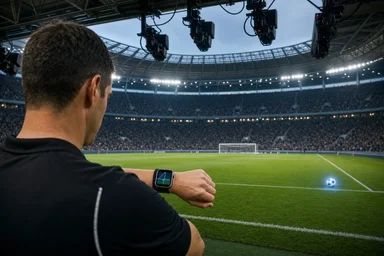
One concept involves a referee wristband that vibrates when an offside is detected, allowing the assistant referee to raise the flag immediately without waiting for a VAR signal. This would eliminate the lag between the incident and the flag, potentially reducing the number of goals scored from offside positions. FIFA tested a wristband prototype in 2023 during the FIFA Club World Cup, but the feedback from referees was mixed. Some liked the haptic alert, while others found it distracting.
The 2026 World Cup, which will be co-hosted by the United States, Canada, and Mexico, is the likely debut for a fully automated system. FIFA's chief technology officer, Nicolás Erickson, has said the organisation aims to have “a decision within 5 seconds, with no human check needed” by the time the tournament begins. But he acknowledged that the technology is not yet ready for prime time. “We need to be absolutely sure it works in every stadium, in every weather condition, before we remove the human safety net,” he said.
Even if fully automated offside arrives, it will not end all controversy. Offside decisions involve judgment about which body parts can legally score, and a machine's interpretation may not always align with the Laws of the Game. IFAB is already debating whether the definition of “offside position” should be adjusted to account for the new technology. As with every innovation in football, the balance between speed and accuracy—and between technology and human judgment—will continue to evolve. The next step is to test the system in lower-tier leagues to gather more data on real-world performance and refine the algorithms before the 2026 World Cup.